
If your child is frightened of water, start with private lessons and move to a group once the fear is gone. If your child is comfortable in water and simply cannot swim yet, a small group class is usually better value and often better learning, because children copy each other. Fear determines the format. Budget determines how long you stay in it.
Parents ask me which is better as though one is. They are different tools. The mistake I see most often is a terrified six-year-old put into a class of eight because the group option was cheaper, spending twelve weeks clinging to the wall while the coach works with the children who will actually move.
How to choose, honestly
| Your child | Better format | Why |
|---|---|---|
| Cries at the pool gate | Private | Fear needs undivided attention and no audience |
| Happy in water, cannot swim | Small group | Peer copying is a powerful teacher |
| Can swim a length, sloppy technique | Group, plus occasional private | Volume from the group, correction from the private |
| Sensory or physical needs | Private, specialist coach | Pace and environment must be adapted |
| Preparing for squad selection | Squad training | Different sport entirely |
A sensible sequence for a fearful child: four to six private sessions to get the face in the water and the body floating, then a small group to build distance among peers. That usually costs less overall than a year of group classes in which nothing happens.
For what one-to-one coaching actually involves, see privateswimming.sg. For children who need an adapted approach, specialneeds.com.sg covers it properly.
What better swimming classes look like from the poolside
Go and watch ten minutes before you pay. Any school that refuses is telling you something.
- Count the children and find the coach. Is the coach in the water, or on a chair? For beginners, in the water.
- Count how many children are moving. If four are queuing at the wall while one swims, you are paying for queuing.
- Watch a correction. Does the coach say “kick harder” or does the coach put a hand on the child’s hip and show them? One is noise. The other is teaching.
- Look at the water depth. Can every child stand with their head clear? If not, where is the coach standing?
- Watch the end of the lesson. Are children leaving happy and tired, or cold, bored and shivering at the wall?
- Ask what happens when a child panics. A good coach answers in specifics. A bad one is surprised by the question.
A reasonable ratio for absolute beginners is small — three or four children to one coach, in water they can stand in. As competence grows, larger groups become fine. If a school runs eight non-swimmers to one coach, walk away.
Questions worth asking before you pay
What is the ratio, and does it change when the class is full? Is the coach’s rescue and first-aid certification current, and when was it last renewed? What is the make-up policy for missed lessons? What does progression look like — how will I know my child has moved up? Is the class in a pool my child can stand up in?
Notice that the coach’s teaching qualification is on that list, but not at the top. Certification tells you someone sat through a syllabus. Watching them teach tells you whether they can. Our overview of coaching credentials is at swimmingcoach.sg, and Sport Singapore publishes what is expected of coaches working here.
Safety, which is not optional
Armbands, floats, noodles and rings are teaching aids. They are not safety devices, and a child wearing them still needs an adult within arm’s reach. Children have drowned wearing armbands.
No class should ever run breath-holding competitions or underwater distance challenges. Prolonged breath-holding can cause shallow-water blackout, a silent loss of consciousness underwater with no struggle and no warning. If you see “who can stay under longest” being run as a game, take your child and leave.
Drowning is quiet. There is no shouting and no splashing. A drowning child goes vertical and still. This is why the coach’s eyes matter more than the coach’s certificate, and why a coach with a phone in hand is disqualifying.
And never leave a child in the care of a class as a substitute for supervision at a condo pool or beach. Lessons reduce risk. They do not remove it.
Common mistakes parents make
- Choosing on price alone. A cheap class a child hates is more expensive than a good one they finish.
- Putting a frightened child in a big group. It rarely resolves, and it can entrench the fear for years.
- Expecting a timeline. Any school that guarantees your child will swim in eight weeks is selling.
- Skipping lessons in the holidays. Water confidence decays quickly in young children.
- Watching from the cafe. Watch a few lessons. You will learn more about the school than any brochure will tell you.
- Pushing a child who is not ready. Forcing a face under water buys you a decade of avoidance.
Frequently asked questions
At what age should my child start swimming classes?
Water familiarisation can begin very young with a parent in the water. Formal instruction generally works from around four, when a child can follow a sequence of instructions.
How long until my child can swim?
Honestly, it varies enormously. Some children swim a length within months; others take a year to put their face in. Neither predicts anything about the adult swimmer they become.
What is a good class size for beginners?
Small. Three or four non-swimmers per coach, in standing-depth water. Beyond that, someone is being ignored.
Are private lessons worth the extra cost?
For a fearful child, yes, and usually for fewer weeks than you expect. For a confident child, a group class often teaches faster.
Should my child wear armbands to class?
Follow the school’s approach. But understand that they are a teaching aid, never a safety device, and they encourage a vertical body position that has to be unlearned.
Where do I find classes near me?
swimmingnearme.sg lists pools, and condoswimming.sg covers lessons in condominium pools, which have their own constraints.
Ten minutes on the poolside tells you more than ten reviews. Watch whether the children are moving, and whether the coach is looking at them.

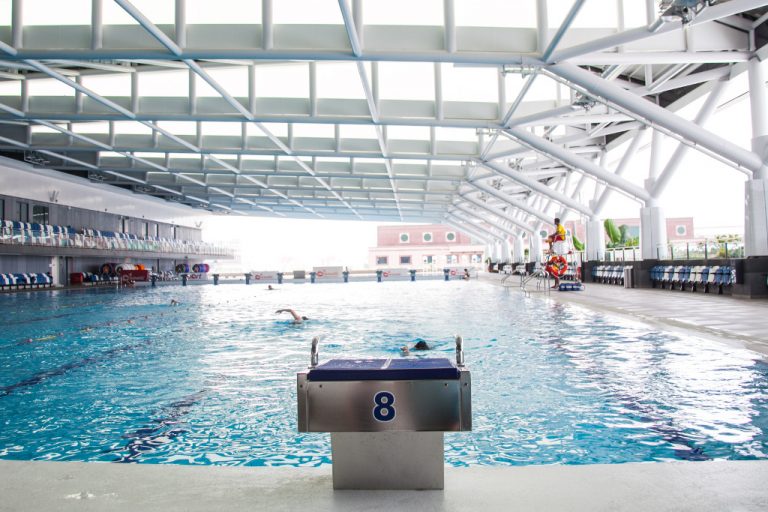

[…] Put eight learners in a lane and two forces switch on at once. The helpful one: modelling and momentum — seeing a peer manage a skill makes your own brain more willing to try it, and turning up is easier when the group expects you. The unhelpful one: comparison — the quiet maths of “everyone got it except me”. A well-run class amplifies the first force and defuses the second. That’s a teaching skill, and it’s worth checking for when you choose a swimming class. […]
[…] solid, then transfer to a complex programme for the stages that need space and depth. Our guide on group versus private classes for your child covers the class-format half of the same […]
Paetos dignissim at cursus elefeind norma arcu. Pellentesque accumsan est in tempus etos ullamcorper, sem quam suscipit lacus maecenas tortor. Erates vitae node metus. Morbi suspendisse a tortor velim pellentesque uter justo magna gravida. Pellentesque accumsan, ex in tempus ullamcorper terminal.
Paetos dignissim at cursus elefeind norma arcu. Pellentesque accumsan est in tempus etos ullamcorper, sem quam suscipit lacus maecenas tortor. Erates vitae node metus. Morbi suspendisse a tortor velim pellentesque uter justo magna gravida. Pellentesque accumsan, ex in tempus ullamcorper terminal.
Paetos dignissim at cursus elefeind norma arcu. Pellentesque accumsan est in tempus etos ullamcorper, sem quam suscipit lacus maecenas tortor. Erates vitae node metus. Morbi suspendisse a tortor velim pellentesque uter justo magna gravida. Pellentesque accumsan, ex in tempus ullamcorper terminal.