
Castle Sports Complex Swimming Pool is one of the cleaner, better-maintained public pools in Singapore’s east — 50-metre main pool, separate teaching tank, reliable lane discipline, and lifeguards on deck throughout every session. For a coach running small-group classes, those details matter more than they might look like they do on paper.
But the pool is only half the equation. The other half is the class itself: how many swimmers share a coach, how well the group is matched by ability, and how much individual feedback each swimmer actually receives per session. If you are evaluating a small-group swimming class — at Castle Sports Complex or anywhere else in Singapore — here is what to look for.
What Makes a Public Pool Like This One Suitable for Group Classes
Not every public pool hosts structured coaching well. The things that make Castle Sports Complex Swimming Pool a reasonable venue for small-group instruction are practical: the pool observes lane discipline, there is a shallow-end teaching area that works for beginners, and the facility is lifeguarded throughout operating hours. That last point matters because a coach running a group lesson cannot also act as your lifeguard. The two jobs require different attention spans, and a responsible coach should never be asked to do both simultaneously.
Defining “Small Group†— the Number That Changes Everything
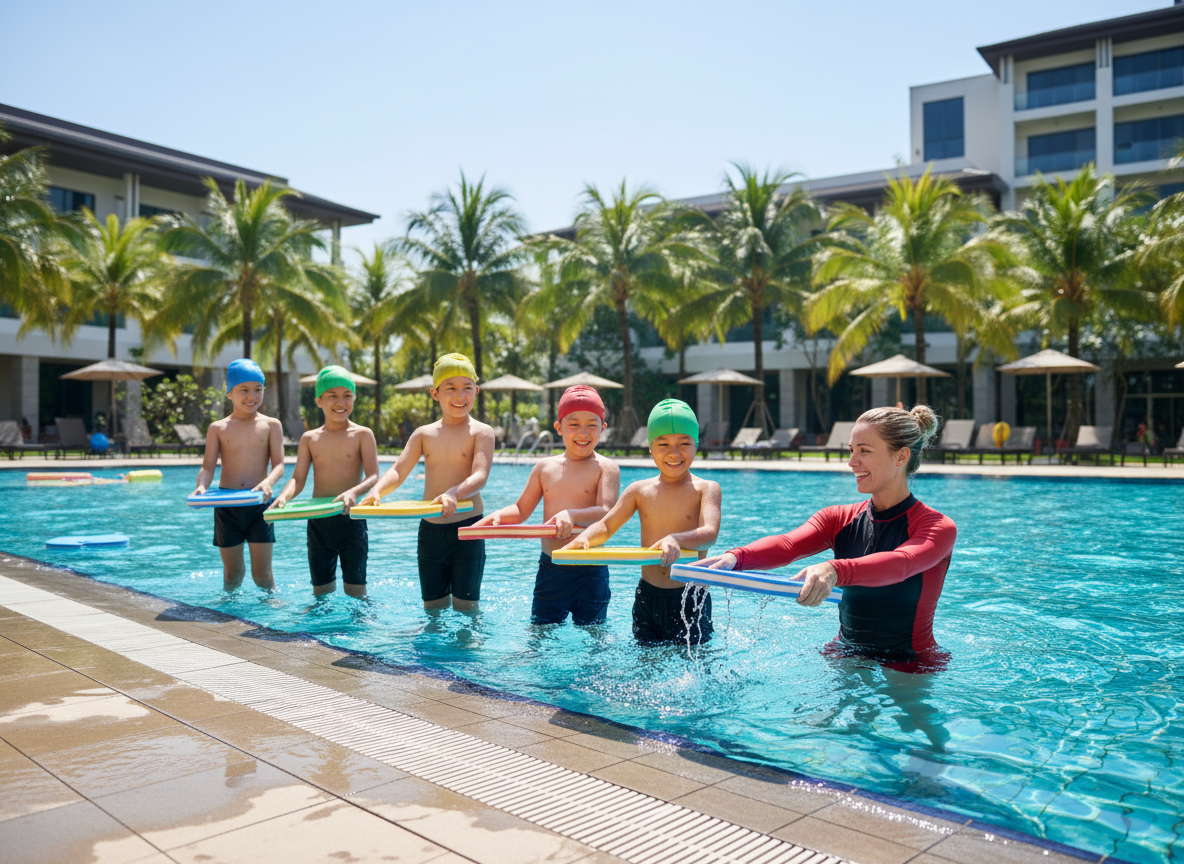
The phrase “small-group class†covers a wide range. A group of three is a very different experience from a group of eight, even if both are advertised under the same label. In Singapore’s independent coaching market, the most useful benchmark is the coach-to-swimmer ratio. A single coach working with more than four swimmers at similar levels will typically lose the ability to observe each swimmer’s technique in real time and correct faults before they embed.
| Group size | Correction rate per swimmer per session | Best suited for |
|---|---|---|
| 1:1 private | Continuous | Specific fault correction, fear management, fast-track progress |
| 2–3 swimmers | High — coach rotates every few lengths | Swimmers at similar levels wanting peer motivation |
| 4–5 swimmers | Moderate — roughly every 2–3 sets | Intermediate swimmers comfortable with some independent practice |
| 6–8 swimmers | Low — often one correction per session | Fitness swim with minimal technical input |
Before booking any group class, confirm the maximum cap the provider uses. If the answer is “it depends†or “we try to keep it reasonableâ€, that is a warning sign. A clear policy — “no more than four per coach†— tells you the provider has thought this through.
Seven Questions Worth Asking Before You Enrol
These apply to any small-group class in Singapore, including those at a public pool venue:
- What is the group size cap, and is it enforced? Ask for the number in writing. “Usually small†is not an answer.
- How are swimmers sorted by level? Placing a post-beginner next to a strong recreational swimmer in the same group wastes both their time. Ask what the assessment process looks like.
- What happens if someone in the group is significantly faster or slower than me? A good provider will move them or suggest a more suitable group. If the answer is “we just adjust the paceâ€, expect the lesson to drag or rush depending on where you sit in that group.
- What are the coach’s qualifications? In Singapore, look for Singapore Swimming Association (SSA) certification or an internationally recognised equivalent. Ask which body issued it and when.
- How does feedback work? Verbal only, or will you receive a written summary? For adults correcting persistent technique faults, a two-line note after class is worth more than twenty cues they cannot recall by the next session.
- How is progression tracked? A programme with no defined progression structure is likely to plateau after a few weeks. Ask what milestone marks movement to the next level.
- What is the cancellation and makeup policy? Public pools in Singapore are subject to weather closures and maintenance shutdowns. Know in advance how a cancelled session is handled.
What a Well-Run Small-Group Lesson Looks Like
A well-run 45 to 60-minute group lesson at a public pool follows a clear structure: a brief poolside warm-up, a main drill block where the coach demonstrates and swimmers repeat a short set, observation with individual cues given at the wall between repeats, and a short wind-down at the end. The coach should be observing from a position where they can see all swimmers simultaneously — standing at the pool edge or crouching at the lane end — rather than swimming alongside one swimmer while others continue unsupervised.
Each swimmer should receive at least two or three specific, personalised corrections per session. If you complete a session without any correction directed specifically at you — not the group in general, but you — the class is likely too large or the coach’s attention is too diffuse to serve you well.
Small-Group vs Private: Choosing the Right Format for Your Goal
At a public pool like Castle Sports Complex, both formats are available through independent coaches. The choice depends on what you need from the current phase of your learning. Private lessons compress the correction cycle: every observation and every drill is targeted at your specific fault pattern. Group lessons work better once you have solid enough basics to benefit from independent practice sets between coach-led corrections, and when the social element keeps you motivated.
Adults who have learned a stroke but want to refine it typically do well in a group of three or four at a similar level. Adults working through significant fear of water, or through a specific injury-related constraint, almost always progress faster with a private coach — at least for the first phase of their learning.
Safety at a Public Pool Group Class
One point that is easy to overlook: in a group class at a public pool, the facility’s lifeguards are there for the general public — they are not assigned to your lane. Your coach is responsible for the session structure, and the lifeguards provide an additional safety layer for the pool as a whole. What this means for you: never attempt breath-holding drills or extended underwater distances in solo practice after your group class ends. Shallow-water blackout can occur without warning even in experienced swimmers, and unsupervised underwater swimming carries serious risk. Keep breath-holding work inside supervised sessions only, and always swim in a lifeguarded environment.
FAQ: Small-Group Swimming Classes at Public Pools in Singapore
Is Castle Sports Complex Swimming Pool suitable for beginners?
Yes. The pool has a shallow teaching area appropriate for adult and child beginners, and the lane structure makes it workable for small-group coaching at most adult levels. Your coach will position the group based on the session’s depth requirements and swimmer comfort.
How often should I attend group classes to make real progress?
Once a week is the minimum for forward movement. Twice a week — one group class plus one independent practice session in between — roughly doubles the rate of technique retention. Three times a week produces faster gains but most adult learners find it difficult to sustain alongside work schedules.
What if the group class moves too fast or too slow for me?
Tell your coach directly. A group that is consistently mismatched for you — not one off day, but session after session — is a wrong fit, and a responsible provider will offer a more suitable group or suggest private lessons for that phase of your development.
Are group classes at public pools cheaper than private lessons?
Per session, yes — typically noticeably so. Per unit of direct coach feedback, the comparison is closer. Private lessons cost more per session but deliver more personalised correction per minute. The question is which resource is currently limiting your progress: cost, or individual attention.
How do I know when to move from a group class to private lessons?
Two clear signs: you have a specific technical fault that keeps returning despite group corrections, or you have plateaued and the group’s pace no longer matches yours. Either warrants a conversation with your coach about switching formats — even temporarily.
Can children join small-group classes at Castle Sports Complex?
Yes, though age-appropriate grouping matters even more for children than for adults. Children should be grouped by both ability level and approximate age — mixing a six-year-old with a ten-year-old in the same group creates attention and confidence disparities that work against both. Ask specifically how the provider handles age separation within a group.
If you are looking for a structured small-group class in Singapore, the format, coach qualifications, and group composition matter at least as much as the venue. Castle Sports Complex Swimming Pool offers the kind of stable, well-managed environment that supports good coaching — what happens in the lane is up to the programme you choose.


Leave a Comment